Otto Berger · 14 October 2026
Adapting Note Organization Techniques to Emerging AI-Assisted Categorization in Digital Platforms
Digital note platforms have shifted how people structure information, and AI-assisted categorization now plays a central role in that transition. Traditional methods relied on manual folders, tags, and hierarchical outlines, yet emerging tools analyze content patterns and suggest groupings without constant user input. Researchers tracking productivity software report that adoption rates for these features climbed steadily through 2025 and into 2026.
Traditional Techniques Meet New Capabilities
Users once created static categories based on project names or broad topics, then maintained those structures over months or years. Folders worked well for fixed taxonomies, while tags allowed cross-referencing across multiple contexts. Observers note that these approaches demanded consistent effort to keep systems accurate, especially as note volumes grew beyond a few hundred entries. Data from platform usage logs shows average note counts per active user rising from 150 in 2022 to over 400 by late 2025.
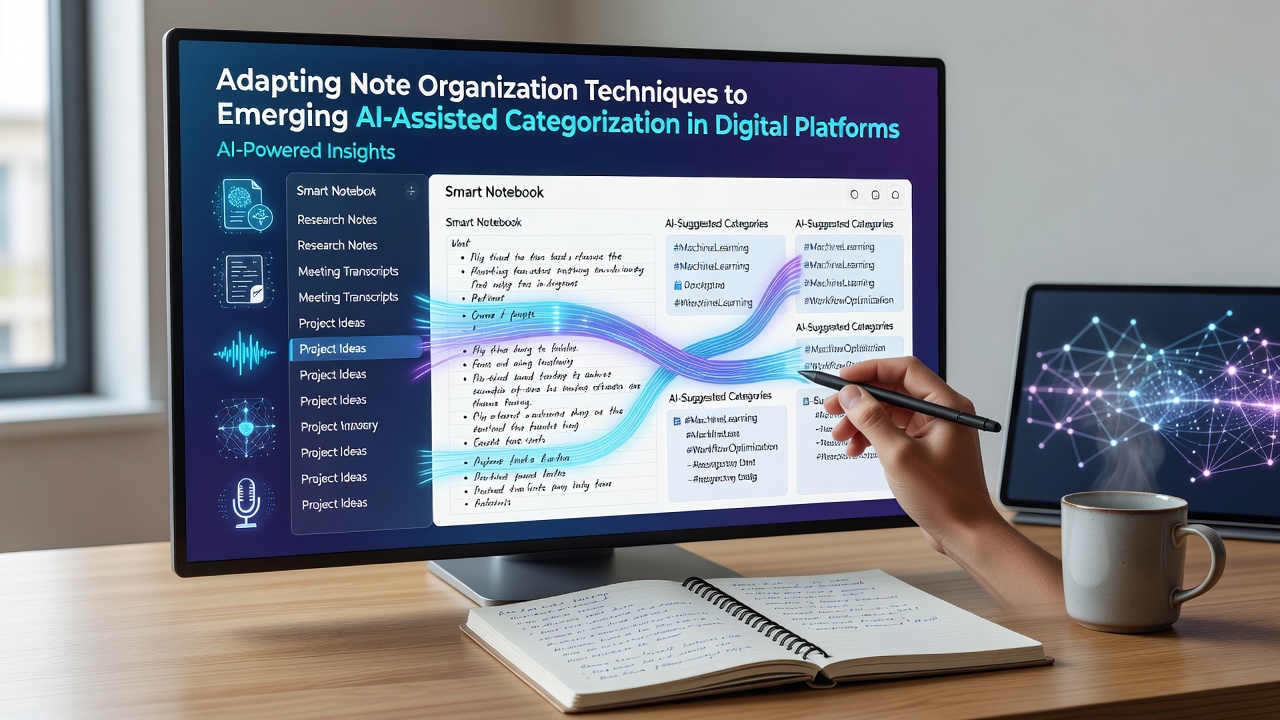
AI models now scan text, extract entities, and propose categories that reflect semantic similarity rather than exact keyword matches. This changes the workflow because suggestions appear during or immediately after note creation, reducing the need for later cleanup sessions. Studies from academic institutions indicate that hybrid approaches, where users review and refine AI outputs, produce more stable long-term archives than fully manual or fully automated systems.
Platform Developments Through October 2026
By October 2026 major applications had rolled out updated categorization engines trained on larger, domain-specific datasets. These updates improved accuracy for specialized fields such as legal research and medical documentation, where precise terminology matters. One study released that month highlighted a 23 percent reduction in time spent on re-categorization tasks among teams using the newest versions. The National Institute of Standards and Technology published guidance on evaluating such systems for reliability and bias, providing benchmarks that developers began incorporating into their release cycles.
Integration with external data sources also expanded. Calendar entries, email threads, and shared documents now feed into the same models, allowing automatic clustering across formats. People working in distributed teams report that shared workspaces reflect these clusters in real time, so everyone sees consistent groupings without manual synchronization.
Adapting Established Methods
Experts recommend starting with existing folder structures and allowing AI suggestions to run alongside them for a trial period. This parallel approach reveals where the new system proposes merges or splits that better match actual content relationships. Over several weeks, users can migrate high-value notes while keeping legacy categories as reference points until confidence in the AI output solidifies.

Tag systems benefit from similar layering. Instead of abandoning custom tags, users map them to AI-generated clusters so that search queries still surface the same results. Research indicates that preserving familiar labels during transition reduces errors and maintains retrieval speed for long-term users.
Training and Feedback Loops
Most platforms now include explicit feedback mechanisms where users accept, reject, or modify suggestions. These signals retrain the underlying models over time, improving personalization without requiring technical configuration. Teams that establish shared review protocols see faster convergence on consistent category vocabularies across members.
Training sessions for new users focus less on taxonomy design and more on interpreting confidence scores and understanding when to override proposals. Documentation from several providers shows that brief onboarding modules covering these topics cut initial misclassification rates by roughly 30 percent.
Security and Compliance Considerations
Because AI categorization processes content at scale, organizations must verify that data handling meets regulatory standards. The Australian government’s AI Ethics Framework outlines principles for transparency and accountability that apply directly to note platforms handling sensitive material. Administrators review audit logs that record which categories were auto-generated versus manually adjusted, supporting compliance reporting.
Conclusion
AI-assisted categorization continues to reshape how digital notes are grouped and retrieved, yet established organization techniques remain relevant when adapted thoughtfully. Parallel use of legacy structures during transition, combined with feedback mechanisms and compliance checks, supports reliable migration. Ongoing platform updates through 2026 demonstrate continued refinement of these capabilities across diverse professional contexts.